
If you live in Melbourne, chances are you have grown up with strong sun and plenty of time outdoors. Australia has some of the highest rates of skin cancer in the world, and regular skin checks are one of the most effective ways to find problems early. The challenge is knowing what a good skin check looks like, and how to choose the right clinic.
This guide walks you through what happens in a proper full‑body skin check, questions to ask when comparing clinics, and how Skintel’s doctor‑led imaging service fits into Melbourne’s skin cancer care landscape.
Why regular skin checks matter in Melbourne
Most skin cancers can be treated very successfully when found early. Cancer Council and SunSmart encourage Australians to get to know their own skin and to see a doctor promptly if they notice new spots or changes in size, shape, colour or texture
Professional skin checks complement self‑examination by providing a thorough, head‑to‑toe assessment with tools such as dermoscopy and medical photography. People at higher risk—such as those with fair skin, many moles, a history of sunburns or a personal/family history of skin cancer—may need regular professional checks every 6–12 months
What happens during a proper full‑body skin check?
Before your appointment
For most clinics, including Skintel, you will be asked to arrive with clean skin and to remove make‑up, fake tan and nail polish from areas being examined. It can help to note any particular spots that worry you so you remember to mention them on the day.
At the start of the appointment, your doctor or melanographer will usually ask about your medical history, family history of melanoma, medications and previous skin cancers or biopsies. This context helps tailor the examination and follow‑up plan.
The examination itself
In a proper full‑body skin check you will usually be asked to undress down to your underwear in a private room, with a gown or drape provided. The clinician then examines your skin from head to toe, including scalp, ears, face, neck, trunk, arms, legs, hands, feet and areas that are often missed such as between the toes and under the breasts.
A handheld dermatoscope (dermoscopy device) is routinely used to examine moles and spots more closely. Dermoscopy is now considered standard of care because it reveals structures beneath the surface that are not visible to the naked eye and improves diagnostic accuracy.
At Skintel, a skin check typically follows a structured four‑step protocol that combines:
-
Body Map (total body photography): High‑resolution images capture your moles and lesions from head to toe, creating a baseline for future comparison.
-
Dermoscopy: Your doctor examines individual lesions in detail using a dermatoscope, guided by the body map images.
-
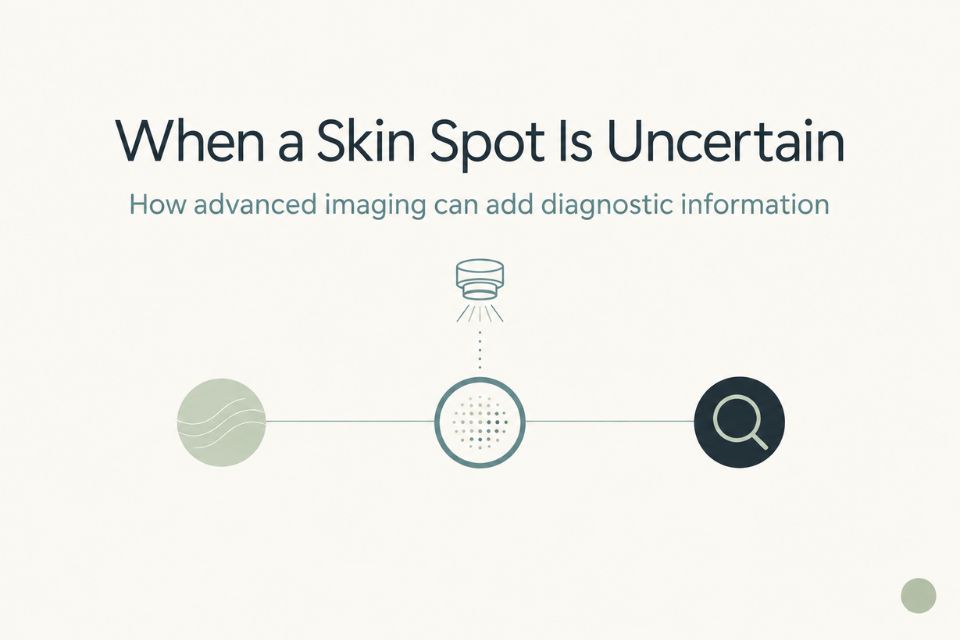
Optical biopsy (reflectance confocal microscopy) when indicated: For selected lesions—particularly on the face or when the diagnosis is uncertain—non‑invasive reflectance confocal microscopy may be used to examine skin cells in detail without cutting the skin.
-
Medical review and report: A doctor reviews all images and findings and prepares a detailed report that can be shared with you and your referring GP or dermatologist.
After the check
At the end of the appointment, your doctor or melanographer should explain what they have found, which lesions are benign, which might need monitoring, and whether any biopsies or further imaging are recommended. Good clinics also provide written information or a report so that you and your GP know what was done and what to look out for next.
At Skintel, reports are routinely sent back to referrers and can be used to guide treatment or ongoing surveillance.
Skin check Melbourne: how to choose the right clinic
There is no single “best” clinic for everyone, but there are important factors to consider when you are weighing up where to go.
Qualifications and experience
Choose a clinic that is clear about who will examine your skin and their training. SunSmart’s consumer guide to skin clinics recommends asking about the qualifications and experience of the person performing your skin check, and whether they are a skin cancer doctor, a dermatologist, a GP with additional skin cancer training or a melanographer.
Many Melbourne clinics offer a mix of services: some visits are with skin cancer doctors, others with dermatologists, and some with melanographers. It is reasonable to ask who will see you, what experience they have with skin cancer, and who reviews any images taken.
Technology and imaging
Standard, thorough skin checks now routinely include dermoscopy; clinics that rely on a quick “torch‑and‑glance” approach may miss subtle lesions. Total body photography and digital mole mapping can be particularly helpful for people with many moles or those at high risk, as they provide a detailed baseline for detecting change over time.
Some centres, including Skintel, also offer advanced imaging such as confocal microscopy (optical biopsy), which provides non‑invasive, high‑resolution views of skin cells and can reduce unnecessary biopsies in selected cases. When comparing clinics, consider whether they have access to these technologies, who interprets the images, and how they integrate with clinical decision‑making.
Process, time and follow‑up
A full‑body skin check usually takes longer than a quick spot check; many reputable clinics schedule 15–30 minutes for a standard visit and longer for complex cases. Very short appointments may not allow time for a careful head‑to‑toe assessment, especially if you have a history of skin cancer
Ask how results will be communicated, whether you will receive a written report, and what the follow‑up plan will be. A good clinic should be willing to explain findings, discuss options and send information back to your regular GP.
Location, cost and access
Practical factors—such as location, parking, public transport and appointment availability—also matter. Fees vary between clinics: some bulk bill, others charge a private fee with a Medicare rebate, and some services such as advanced imaging or mole mapping may not be fully covered.
Skintel lists its fees and services transparently, including the cost of a comprehensive skin check that incorporates body mapping and doctor review. When you book anywhere, it is reasonable to ask about consultation fees, potential biopsy or procedure costs, and whether follow‑up imaging attracts separate charges.
What makes a Skintel skin check different?
Skintel is a specialist skin imaging service based on St Kilda Road in Melbourne, focusing on detailed assessment and diagnosis rather than surgery. Your model combines advanced imaging technology with experienced medical review to support both patients and their referring doctors.
Key features include:
-
Comprehensive imaging: Full‑body body mapping captures detailed photographs of your skin, which can be compared over time to detect new or changing lesions.
-
Doctor‑led dermoscopy: Experienced doctors review lesions with dermoscopy and correlate findings with the body map.
-
Confocal microscopy (optical biopsy): Where appropriate, non‑invasive confocal imaging provides cellular‑level detail without cutting the skin, helping to clarify difficult cases and reduce unnecessary biopsies.
-
Collaborative care: Skintel works in partnership with GPs, dermatologists and surgeons; once a diagnosis is made, treatment is arranged through your usual treating team in line with Australian clinical guidelines.
How often should you have a skin check?
There is no one‑size‑fits‑all schedule for skin checks. Cancer Council and other Australian authorities suggest that people at higher risk may need regular professional examinations, often every 6–12 months, while those at average risk may be guided by their GP.
Factors that increase risk include: fair or freckled skin, a large number of moles, a history of sunburn or solarium use, outdoor occupations, and a personal or family history of melanoma or non‑melanoma skin cancer. Your GP or dermatologist can help decide an appropriate interval and whether additional tools—such as body mapping or confocal microscopy—might be useful in your case.
Skintel’s imaging and reporting can form part of an ongoing surveillance plan, particularly for patients who are already under the care of a dermatologist or skin cancer clinic.
Frequently asked questions
Do I really need a full‑body skin check, or can I just get one mole checked?
If a particular mole worries you, it is sensible to have it examined. However, many skin cancers develop in places people do not notice themselves, such as the back, scalp or behind the ears. A full‑body skin check gives your doctor the best chance of finding early cancers you might otherwise miss.
How long does a skin check take?
The length of a skin check depends on your risk factors and the clinic’s processes, but many thorough full‑body checks take around 15–30 minutes. Comprehensive imaging and confocal microscopy assessments can take longer, especially if you have many moles or complex lesions.
What should I wear to a skin check appointment?
Wear comfortable clothing that is easy to remove and avoid heavy make‑up, fake tan and nail polish on the day, particularly over areas of concern. You will usually be provided with a gown or sheet and a private space to undress.
Will my skin check be covered by Medicare?
Many clinics charge a private fee with a Medicare rebate for standard consultations, while some bulk bill; additional procedures such as biopsies, excisions, mole mapping or advanced imaging may not be fully covered. Confocal microscopy currently does not have a specific Medicare item number, though some costs may be offset in certain circumstances. It is always best to ask about fees and rebates when you book.
How soon will I get my results?
For many benign lesions, your doctor can give you reassurance immediately. If a biopsy is needed, pathology results usually take several days. When imaging such as body mapping or confocal microscopy is performed, an experienced doctor reviews the images and provides a report that can be sent to you and your GP or dermatologist.
Conclusion and next steps
In a city like Melbourne, where sun exposure and skin cancer risk are high, choosing a quality skin check is an important health decision. Look for clinics that offer doctor‑led care, use appropriate imaging technology and take the time to examine your whole skin and explain the results.
If you have noticed a new or changing spot—or if you are overdue for a check—consider speaking with your GP or dermatologist about arranging a professional skin examination. If advanced imaging such as body mapping or confocal microscopy might be helpful, you or your doctor can contact Skintel to discuss referral options and how our diagnostic service can fit into your broader care
References
-
Cancer Council NSW. Checking for skin cancer. Cancer Council NSW; 2025.
-
Cancer Council Australia. Skin cancers – signs, symptoms and checks. Cancer Council Australia; 2026.
-
SunSmart Victoria. Consumer guide to skin clinics. SunSmart; 2024.
-
Cancer Institute NSW. Detect skin cancer early – reduce your skin cancer risk. Cancer Institute NSW; 2024.
-
Cancer Council Victoria. Non‑melanoma skin cancer (BCC & SCC) – overview. Cancer Council Victoria; 2018.
-
Cancer Council Australia. Clinical practice guidelines for the management of melanoma. Cancer Council Australia; 2026.
-
Skintel. Our Services – skin health and skin cancer detection. Skintel; 2026.
-
Skintel. Body Map – skin health and skin cancer detection. Skintel; 2025.
-
Skintel. Referrals – skin cancer checks and confocal microscopy. Skintel; 2025.
-
Skintel. About Us – Skintel skin imaging service. Skintel; 2024.
-
Skintel. Frequently asked questions – skin cancer detection and optical biopsy. Skintel; 2024.